The Power Dilemma — Corded Freedom vs. The Battery Marriage
If you walk into a big-box home improvement store, the tool aisle looks like a massive wall of plastic and lithium-ion batteries. Marketing teams have done a great job convincing us that if a tool has a power cord attached to it, it belongs in a museum. They want you to buy the cordless drill, the cordless saw, the cordless sander, and heck, even the cordless workshop vacuum.
But here is the quiet secret of the tool world: going cordless isn’t just a one-time purchase. It is a long-term contract with a specific battery system.
If you want to build cool, functional projects without drowning in credit card debt, you need to know exactly when to cut the cord and when to plug in. Let’s break down the strategy using the exact setup I use in my shop every single week.
The Battery Ecosystem Trap
When you buy a cordless tool, the tool itself is often the cheapest part of the equation. The real cost is hidden in the black and yellow, red, blue, or green plastic bricks that slide into the bottom of it.

The most expensive part of modern woodworking isn’t the lumber—it’s the battery ecosystem you choose.
If you buy a cheap cordless drill from one brand, a circular saw from another, and a jigsaw from a third because they were all individually on sale, you win a prize you don’t want: a workbench covered in three different chargers, three different battery styles, and zero compatibility.
To build an efficient budget shop, you must pick one primary battery platform for your handheld, high-mobility tools. In my shop, I split my loyalty between the Ryobi 18V One+ system and the Kobalt 24V max lineup. They aren’t pristine, shelf-queen tools. They are scuffed, covered in sawdust, and well-traveled because they work. By sticking to a specific ecosystem, you only buy the expensive battery-and-charger starter kit once. After that, you can buy “tool-only” options at a fraction of the price.
The Non-Negotiable Cordless Tool (The Drill)
If there is one tool in your shop that absolutely must be cordless, it’s your drill.
Think about building a basic weekend project—like a heavy-duty garage storage shelf or a simple outdoor potting bench. You are constantly moving around the workpiece. You are pre-drilling a pilot hole on the left side, driving a pocket screw on the right side, and flipping the piece over to secure the legs.

Mobility matters. A cordless drill lets you navigate around a project without tripping over cords.
If you use a corded drill for assembly, you will spend half your workshop time untangling an extension cord from the table legs or dragging the cord across your freshly sanded wood. A quality cordless drill gives you the freedom to build anywhere—whether that’s on your workbench, the garage floor, or out in the driveway. Look for a starter bundle that includes two batteries. That way, one is always ready on the charger while the other is performing work.
The Case for Keeping the Cord (Saws)
While the drill needs to be free, your cutting tools are a completely different story. This is where you can save a massive amount of upfront cash while actually gaining more capability.
Cutting through thick lumber like a 2×4 or a sheet of 3/4-inch plywood takes an immense amount of continuous energy. To get that kind of muscle out of a cordless circular saw or jigsaw, you have to buy their premium, high-voltage brushless models paired with massive, expensive batteries. If you try to use a cheap, entry-level cordless saw with a standard slim battery, the blade will bog down, pinch, and drain the battery to dead in about ten cuts.

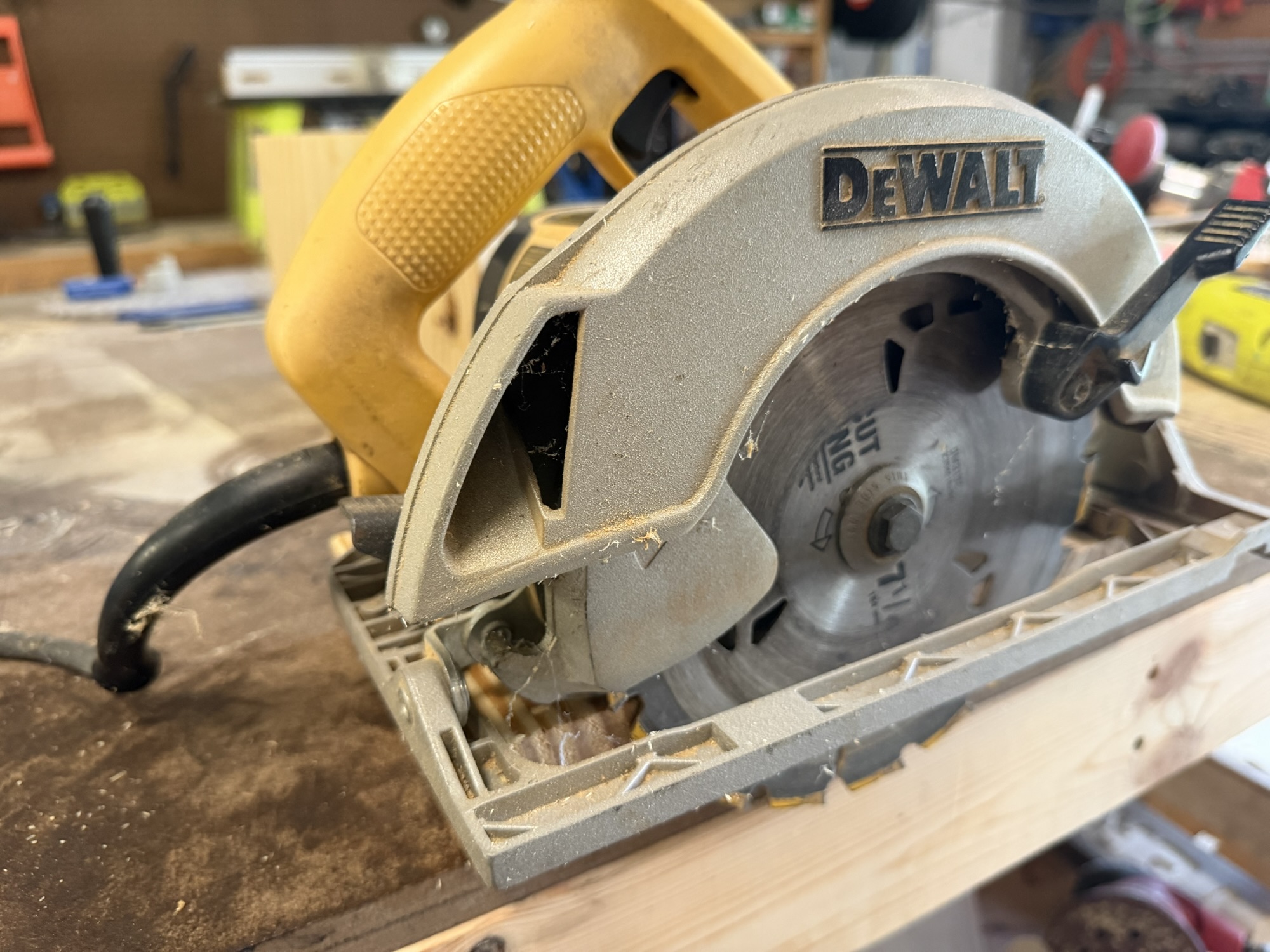
Unlimited runtime and zero power drops. A corded saw means you never have to stop mid-cut to swap a battery.
Instead of dropping hundreds on a high-end cordless cutting setup, stick to a corded circular saw and jigsaw. A budget-friendly, plugged-in saw gives you maximum, unyielding torque from the first cut to the hundredth. You never have to worry about the tool losing steam halfway through a long rip cut, and you’ll never find yourself standing around waiting for a battery to charge just so you can finish your project. Unless you are building off-grid in the middle of the woods, a simple extension cord is the cheapest power upgrade you can buy.
Welcome to My Shop (Ryobi vs. Kobalt)
I don’t review tools that I just pulled out of a pristine, untouched box. The gear on my workbench has earned its keep. If you look around my garage, you’ll see a mix of Ryobi green and Kobalt blue. I chose these two specific ecosystems because they are the kings of the budget-friendly workshop, but they serve two different purposes.

The hybrid shop. Mixing Ryobi and Kobalt lets me get the best of both worlds without breaking the bank.
Now, you might be thinking: ‘Wait, didn’t you just warn me against the multiple-battery trap?’ You catch on quick. I use both because my shop evolved over time. I started strictly with Ryobi for their massive variety of DIY lifestyle tools. But as my projects grew larger and I needed heavier, high-torque work for building outdoor structures, I expanded into Kobalt’s higher-voltage platform specifically for their heavy-duty brushless drill and impact driver. The rule still applies: I don’t buy random brands on a whim. I have two deliberate, organized battery stations, and every cordless tool I buy must fit into one of those two families.
Here is how I view them for a starter shop:
- The Ryobi 18V System: This is the ultimate “gateway” platform. Ryobi has a massive, unmatched lineup of tools. Once you have their battery, you can buy cheap, specialized bare tools like hand vacuum cleaners, orbital sanders, or workshop lights. It is the perfect ecosystem for expanding your shop’s versatility on a budget.
- The Kobalt 24V System: When I need sheer, heavy-duty grunt work—like driving massive lag screws or drilling through tough materials—I reach for my Kobalt gear. Their 24-volt platform offers an incredible power-to-price ratio, and their brushless motors punch way above their weight class, giving you near-professional durability without the premium price tag.
By picking one (or both) of these accessible brands and keeping your heavy-draw saws corded, you can build an incredibly capable, highly authentic workshop for less than the cost of a single high-end industrial tool.
Stop Planning, Start Building
At the end of the day, a workshop isn’t defined by the color of your tools, the cost of your batteries, or how clean your garage floors look in a photograph. A workshop is defined by the sawdust on your boots and the projects you leave behind.
By avoiding the battery trap, keeping your heavy-cutting saws corded, and choosing a reliable, budget-friendly platform like Ryobi or Kobalt, you can bypass the marketing hype. You don’t need to spend thousands of dollars just to get permission to create things with your hands. Grab your four basic tools, clear off a spot on the driveway, and build something cool this weekend. Your skills will grow with every single cut.
Over to You!
I want to hear from you. Are you trying to plan out your very first tool purchase, or are you currently stuck trying to manage a mountain of different battery chargers?
What is the first project you want to tackle with a simple, four-tool setup? Drop a comment below, tell me what you’re building, and let’s talk shop!
Leave a Reply