If you scroll through woodworking Instagram or YouTube, it’s easy to feel broke before you even buy your first piece of lumber. You see creators working in pristine, climate-controlled garages lined with $3,000 table saws, industrial dust collection systems, and walls covered in gleaming, specialized hand planes.
It makes for great video, but it sends a dangerous message to beginners: Woodworking is a rich person’s game.
Here is the truth the internet won’t tell you: you do not need a factory to build furniture. In fact, if you have a patch of driveway, a pair of safety glasses, and four basic tools, you already have everything you need to start building beautiful, functional weekend projects.
Let’s look at the only four tools you actually need to buy today—and the one golden rule that will save your wallet as your skills grow.
The Essential 4 (Plus 1 Layout Duo)
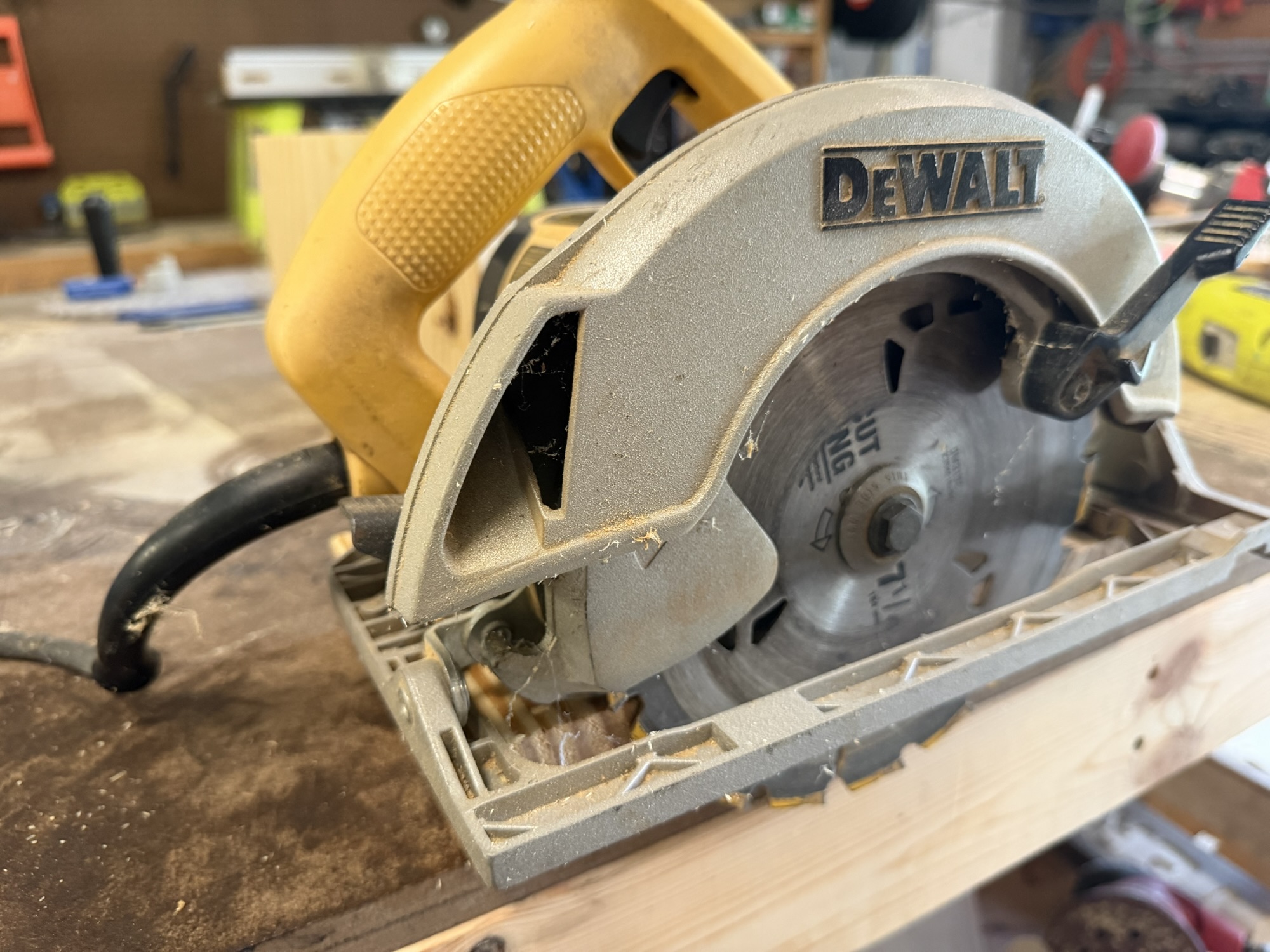
1. The Workhorse: The Circular Saw

Think of the circular saw as your portable table saw. When it comes to breaking down large sheets of plywood or crosscutting dimensional lumber like 2x4s, this is your primary go to. You don’t need a massive machine taking up the center of your garage; a reliable circular saw can handle nearly every straight cut a weekend build requires.
2. The Assembler: The Cordless Drill

Wood clamps are expensive, and advanced wood joinery takes years to master. A quality cordless drill bypasses both hurdles. It lets you pre-drill holes and drive screws to pull your projects together instantly and securely. From building basic workbenches to hanging shelves, it is the ultimate assembly tool.
3. The Stylist: The Jigsaw
If the circular saw handles the straight and heavy lifting, the jigsaw handles the personality. It is safe, lightweight, and highly approachable. Use it to cut smooth curves, create organic shapes for furniture legs, or cut out internal notches. It transforms blocky, basic shapes into custom pieces.
4. The Precision Anchor: A Quality Speed Square
The secret to professional-looking furniture isn’t expensive lumber—it’s square cuts. A quality speed square gives you an instant 90-degree and 45-degree reference line. Even better, you can press it flat against your wood and use it as a physical guide rail for your circular saw, guaranteeing perfectly straight cuts every single time.
The Lifeline: A Reliable Tape Measure
You cannot build what you cannot accurately measure. Pair your speed square with a standard, easy-to-read tape measure. Together, these two form your layout duo, protecting you from the absolute worst feeling in woodworking: cutting a piece of wood an eighth of an inch too short.
The “No Blueprint” Approach to Gear
Once you have these core tools, a dangerous temptation creeps in. You start thinking, “What do I buy next? A router? A miter saw? A drill press?” You walk through your local big box store and they all start calling you.
Stop right there.
The biggest mistake you can make is buying tools for a workshop you hope to have. Instead, buy them only for the project right in front of you.
Let your builds dictate your budget. If you want to build a coffee table and realize you need a specific pocket-hole jig to hide the screws, buy it then. If your next project doesn’t require it, that money stays in your wallet. This keeps your hobby grounded in real-world problem solving, preventing you from drowning in expensive, unboxed gear you don’t actually know how to use.
The Upgrade Path: When to Scale Up
So, when do you actually upgrade? You upgrade when your current tools stop you from growing.
Think of your workshop as an evolving ecosystem. You shouldn’t buy a specialized tool because it looks cool; you buy it because your basic tools are actively costing you time or limiting your creativity.
Here is a simple roadmap for your first real upgrades:
- The Miter Saw: Buy this when you are tired of manually squaring up dozens of repeating cuts for a large shelving unit or fence.
- The Router: Buy this when you want to move past basic block edges and start adding professional decorative profiles, flush trims, or hidden joinery channels.
- The Table Saw: Buy this when your project list demands perfectly identical, ultra-precise rip cuts on large sheets or hardwood boards that a circular saw simply cannot do efficiently.
Just Start Making
Woodworking is about the connection between your hands, your mind, and the wood. The tools are just the bridge. By starting small with your core setup—the circular saw, drill, jigsaw, speed square, and tape measure—you force yourself to learn the fundamentals of precision, assembly, and problem-solving.
Pick a simple weekend project, head to the lumber yard, and start making. Your workshop will grow naturally alongside your skills.
Over to You!
You don’t need a massive budget or a commercial garage to become a woodworker—you just need to take that first step.
What is the very first project you plan to build with your minimalist starter kit? Or, if you’re already building, what’s the one tool you realize you can’t live without?
Drop a comment below and let’s talk shop!
Leave a Reply